

All Spontaneous Processes Are Exothermic
xx.iii: Spontaneous and Nonspontaneous Reactions
- Folio ID
- 53923
Nitroglycerin is a tricky substance. An agile ingredient in dynamite (where it is stabilized), "raw" nitroglycerin is very unstable. Physical shock will crusade the fabric to explode. The reaction is shown below.
\[4 \ce{C_3H_5(ONO_2)_3} \rightarrow 12 \ce{CO_2} + 10 \ce{H_2O} + vi \ce{N_2} + \ce{O_2}\nonumber \]
The explosion of nitroglycerin releases big volumes of gases and is very exothermic.
Spontaneous Reactions
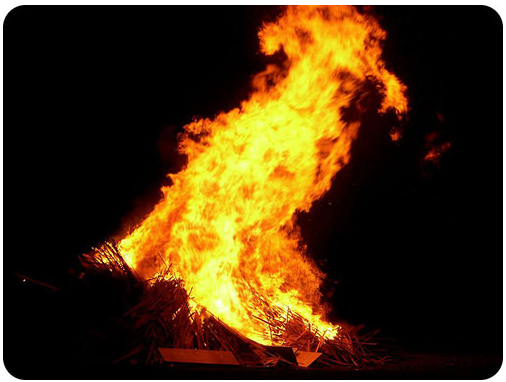
Reactions are favorable when they effect in a subtract in enthalpy and an increase in entropy of the organisation. When both of these conditions are met, the reaction occurs naturally. A spontaneous reaction is a reaction that favors the formation of products at the weather under which the reaction is occurring. A roaring blaze is an example of a spontaneous reaction, since it is exothermic (there is a subtract in the energy of the system as energy is released to the surroundings equally estrus). The products of a fire are composed partly of gases such as carbon dioxide and water vapor. The entropy of the arrangement increases during a combustion reaction. The combination of energy decrease and entropy increment dictates that combustion reactions are spontaneous reactions.
A nonspontaneous reaction is a reaction that does non favor the formation of products at the given prepare of conditions. In order for a reaction to be nonspontaneous, it must be endothermic, accompanied by a decrease in entropy, or both. Our atmosphere is composed primarily of a mixture of nitrogen and oxygen gases. One could write an equation showing these gases undergoing a chemical reaction to form nitrogen monoxide:
\[\ce{N_2} \left( yard \correct) + \ce{O_2} \left( g \right) \rightarrow 2 \ce{NO} \left( g \correct)\nonumber \]
Fortunately, this reaction is nonspontaneous at normal temperatures and pressures. It is a highly endothermic reaction with a slightly positive entropy change \(\left( \Delta Southward \right)\). Nitrogen monoxide is capable of beingness produced at very loftier temperatures and has been observed to form as a result of lightning strikes.
One must exist careful not to misfile the term spontaneous with the notion that a reaction occurs quickly. A spontaneous reaction is 1 in which product formation is favored, even if the reaction is extremely slow. A piece of paper will not suddenly burst into flames, although its combustion is a spontaneous reaction. What is missing is the required activation free energy to get the reaction started. If the paper were to be heated to a high plenty temperature, it would begin to burn down, at which signal the reaction would proceed spontaneously until completion.
In a reversible reaction, one reaction management may be favored over the other. Carbonic acid is present in carbonated beverages. It decomposes spontaneously to carbon dioxide and water, according to the following reaction.
\[\ce{H_2CO_3} \left( aq \correct) \rightleftharpoons \ce{CO_2} \left( grand \right) + \ce{H_2O} \left( l \right)\nonumber \]
If you were to start with pure carbonic acid in water and allow the system to come to equilibrium, more than \(99\%\) of the carbonic acid would be converted into carbon dioxide and h2o. The forward reaction is spontaneous because the products of the forrad reaction are favored at equilibrium. In the reverse reaction, carbon dioxide and h2o are the reactants, and carbonic acid is the product. When carbon dioxide is bubbled into water, less than \(1\%\) is converted to carbonic acid when the reaction reaches equilibrium. The reverse reaction, as written higher up, is non spontaneous.
Summary
- Spontaneous and nonspontaneous reactions are defined.
- Examples of both types of reactions are given.

All Spontaneous Processes Are Exothermic,
Source: https://chem.libretexts.org/Bookshelves/Introductory_Chemistry/Introductory_Chemistry_%28CK-12%29/20:_Entropy_and_Free_Energy/20.03:_Spontaneous_and_Nonspontaneous_Reactions
Posted by: mattosminquirwas.blogspot.com
0 Response to "All Spontaneous Processes Are Exothermic"
Post a Comment